

Fencing injury prevention starts before the first advance, retreat, or lunge. Beginners and parents can lower avoidable risk by warming up dynamically, building footwork volume gradually, checking equipment, recovering between sessions, and speaking up when movement or pain changes. This guide explains practical habits for safer learning without promising that any routine can prevent every injury or replace advice from a qualified medical professional.
What does fencing injury prevention involve?
Fencing injury prevention is a risk-reduction approach, not a guarantee. It combines a prepared body, sound technique, appropriate equipment, sensible training loads, and enough recovery to repeat quality movement. A beginner’s goal is not to train through discomfort. The goal is to learn positions and actions with control, notice warning signs early, and get qualified help when a problem falls outside normal training fatigue.
Fencing places repeated demands on the legs, hips, trunk, shoulder, forearm, and hand. The sport is also asymmetric because a fencer usually leads with the same side. That makes balanced preparation and coaching especially useful. The UIPM Injury Prevention Guidelines similarly emphasize progressive footwork, single-leg strength and balance, hip and adductor conditioning, trunk and upper-limb conditioning, adequate space, and regular equipment checks for fencing.
How should a beginner warm up for fencing?
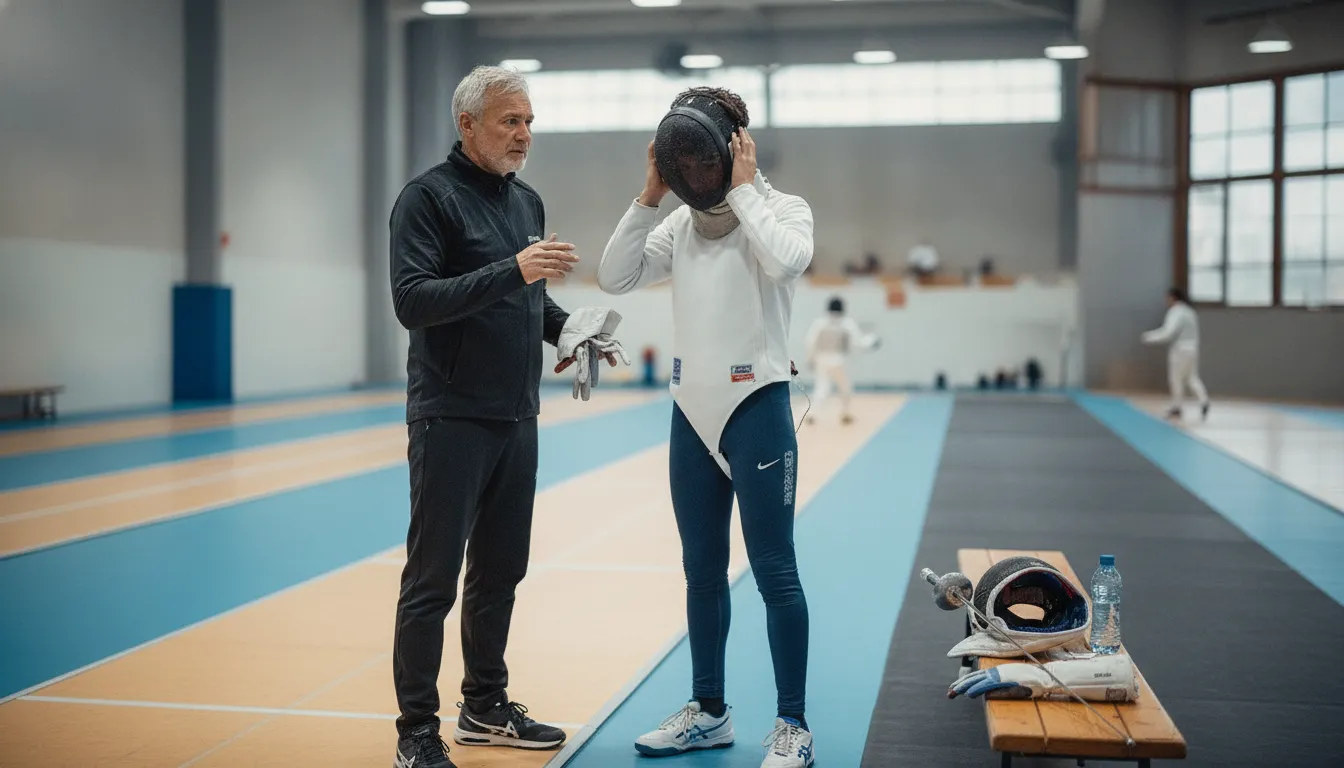
A good fencing warm-up gradually raises body temperature, moves the joints through useful ranges, and rehearses the sport’s actions at low intensity before faster work. It should feel like preparation, not a test. Begin with easy whole-body movement, add dynamic mobility, then progress to controlled advances, retreats, changes of direction, and simple blade actions. The USA Fencing warm-up guide for kids uses short activities that develop coordination, reaction, acceleration, deceleration, and sport-specific movement.
- Raise temperature: Walk, jog, skip, or use another easy movement that does not create pain.
- Mobilize dynamically: Use controlled leg swings, arm circles, torso turns, and ankle movement rather than forcing long static stretches before explosive work.
- Rehearse fencing positions: Move into en garde, then practice small advances and retreats with quiet feet and a stable torso.
- Progress the pace: Add direction changes and short, controlled lunges only after balance and alignment look consistent.
- Keep the first actions easy: Save fast bouting and hard repetitions for after the body and attention are ready.
Coaches may adjust the warm-up for age, experience, the day’s lesson, and the facility. A child who is still learning basic balance may need fewer movements and more demonstrations. An adult returning after time away may need a slower progression. There is no single warm-up that is right for every person, so a supervised class is preferable to copying an advanced athlete’s routine.
How can beginners build footwork and training volume safely?
Beginners should increase one training demand at a time, such as duration, speed, complexity, or the number of lunges. Keep the movement precise before making it longer or faster. When fatigue causes the front knee to collapse inward, the feet to cross, the torso to lean, or the recovery to become uncontrolled, reduce the drill or stop for the day. The existing Fencing Sports Academy footwork guide makes the same distinction between practicing movement quality and simply doing more repetitions.
| Training focus | Beginner priority | Useful coaching question |
|---|---|---|
| Stance | Balanced weight and comfortable posture | Can you hold the position without gripping or wobbling? |
| Advances and retreats | Quiet, controlled steps without crossing the feet | Can you keep distance while staying ready to change direction? |
| Lunges | Stable landing and controlled recovery | Can you return without losing knee, hip, or trunk alignment? |
| Speed | Short efforts with full attention | Does faster movement preserve the same technique? |
| Bouting | Supervised rounds matched to experience and readiness | Can you make safe decisions while tired? |
Training load includes more than time on the piste. School, work, travel, sleep, other sports, growth, and tournament stress all affect how a fencer responds. A sudden jump from occasional practice to several demanding sessions can expose a weakness that was not obvious at lower volume. Tell the coach about a recent change in schedule, a prior injury, or unusual fatigue so the session can be adapted.
What equipment and footwear checks reduce avoidable risk?
Well-fitted equipment cannot eliminate injury risk, but it helps a fencer move, see, and participate as intended. Before practice, check that the mask, jacket, glove, breeches, shoes, and other required protective items are appropriate for the session and fit the athlete. A child may outgrow equipment quickly, while a frequently used item may wear out before it looks obviously damaged.
- Inspect the mask, bib, strap, jacket, breeches, glove, and body cords for damage or unusual wear.
- Make sure clothing allows movement without loose pieces that interfere with footwork or equipment.
- Wear clean athletic or fencing shoes with secure fastening and a sole suited to the training surface.
- Check that the piste and surrounding area are clear, dry, and large enough for the planned activity.
- Ask a coach to review questionable equipment instead of using it until a problem is understood.
- Air out damp gear after practice and avoid leaving wet equipment compressed in a bag.
For a deeper care routine, use the Fencing Sports Academy guide to fencing gear maintenance. A new fencer does not need to guess what to buy on the first day. Ask the academy which equipment is supplied for an introductory class and which items are appropriate to purchase later.
Why do recovery, hydration, and rest matter?
Recovery gives the body and nervous system time to adapt to practice. It also helps a beginner return with the concentration needed for accurate footwork and safe decisions. Hydrate during the day, eat regular meals that support activity, sleep consistently, and include easier days when training has been demanding. These habits are basic, but they are often more useful than adding another hard workout to a tired week.
Use the next session as feedback. General tiredness that improves with rest is different from pain that persists, worsens, changes movement, or appears at rest. Keep a simple note of practice days, unusual soreness, sleep, and any change in technique. This can help a parent, coach, athletic trainer, or clinician see a pattern without turning the fencer into their own diagnostician.
Cross-training can support general fitness, but it should complement rather than compete with fencing practice. The academy’s fencing cross-training guide discusses strength, mobility, agility, and endurance while emphasizing age-appropriate work and recovery between demanding sessions.
Which areas do coaches watch most closely?
Coaches commonly watch the knees, ankles, hips, groin, lower back, shoulder, elbow, wrist, and hand because fencing combines repeated single-leg actions, rapid stops, lunges, and blade work. This does not mean discomfort in one of these areas identifies a specific injury. It means that changes in alignment, balance, range of motion, or movement quality deserve attention rather than dismissal.
A 2024 retrospective review of 186 fencing patients treated in sports medicine and orthopedic clinics found that 73% of recorded injuries involved the lower extremities. Within that clinical sample, the knee was the most frequent lower-extremity location, followed by the ankle and hip. The study is useful context, not a prediction for every beginner or a measure of injury rates in all fencers. Read the study, Injury Patterns in Fencing Athletes, for its population and limitations.
For a beginner, the most helpful response is specific observation. Does the athlete favor one leg, shorten a stride, avoid a direction, land differently, or lose posture only after a certain number of repetitions? A coach can modify the drill and recommend that the family seek an appropriate professional evaluation when needed.
When should a fencer stop and seek medical advice?
Stop the activity when pain is sharp, sudden, increasing, or changing the way the fencer moves. Stop as well after a fall, collision, suspected fracture, dislocation, or head impact. Seek prompt medical guidance for severe pain, major swelling or bruising, visible deformity, unusual weakness, numbness, instability, inability to bear weight, or an inability to move normally. The National Institute of Arthritis and Musculoskeletal and Skin Diseases sports injury guidance describes these as signs that warrant attention, especially when symptoms are severe or persistent.
- During practice: Tell the coach, stop the drill, and do not try to hide symptoms to finish a bout.
- After a head impact: Remove the fencer from activity and follow qualified medical or event personnel guidance. Do not allow a suspected concussion to become a test of toughness.
- For symptoms that persist: Arrange an evaluation from a qualified healthcare professional who can assess the athlete’s age, history, and sport demands.
- Before returning: Follow the clinician’s instructions. A coach can help with training changes, but a coach does not provide diagnosis or medical clearance.
British Fencing’s concussion guidance uses the simple principle “if in doubt, sit them out,” and USA Fencing’s concussion policy emphasizes qualified medical oversight and a gradual, symptom-free return-to-sport process. Parents and athletes can review the British Fencing concussion guidance and discuss questions with a medical professional. This article is general education, not a diagnosis, treatment plan, or clearance to return to fencing.
How does supervised instruction support safer progression?
Supervised instruction helps a beginner learn the difference between productive effort and deteriorating technique. A qualified coach can demonstrate a stance, adjust the pace, pair students thoughtfully, observe repeated movement, and stop a drill when control fades. That feedback is difficult to reproduce alone, especially when a new fencer is also trying to remember rules, distance, blade position, and safety procedures.
At Fencing Sports Academy in Fairfax, Virginia, beginners can ask about membership-based group classes, private lessons, and seasonal camps. These formats serve different needs. Group classes add structure and peer learning. A private lesson can focus on an individual technical issue. A camp can provide a concentrated experience during a school break, with supervision and planned activities. None is a promise of injury prevention, but each can give a fencer a clearer progression than unsupervised intensity.
FSA teaches foil, epee, and sabre, so the coach can also help a family understand how weapon choice, age, experience, and goals affect the first steps. Share previous injuries and current activities honestly. The more accurate the context, the easier it is to choose an appropriate starting point and communicate about any concern.
What is a simple fencing injury prevention checklist?
Use this checklist before and after a beginner’s training session. It is a practical reminder, not a medical screening tool.
- Arrive with enough time to settle in, hydrate, and complete the planned warm-up.
- Wear secure athletic clothing and properly fitted protective equipment.
- Tell the coach about prior injuries, new pain, illness, poor sleep, or a major change in activity.
- Begin with controlled movement and increase speed only when technique remains stable.
- Keep footwork volume appropriate to the fencer’s experience and the day’s overall load.
- Stop when pain, weakness, dizziness, balance problems, or altered technique appears.
- Cool down with easy movement, replace fluids, eat normally, and protect sleep.
- Seek qualified medical advice for significant, persistent, or worsening symptoms before returning.
Safe participation is built through consistent small decisions. A warm-up, a gear check, a rest day, or an honest conversation with a coach may seem ordinary, but together these habits support longer, more enjoyable development.
Frequently Asked Questions
Is fencing safe for beginners?
Fencing can be a well-supervised sport for beginners, but no sport is risk-free. Learning correct technique, using appropriate protective equipment, progressing gradually, and reporting symptoms early can reduce avoidable risk. A coach can adapt activities to the fencer’s age, experience, and readiness.
What is the best warm-up before fencing?
The best warm-up depends on the athlete and the session, but it generally progresses from easy whole-body movement to dynamic mobility, balanced fencing positions, controlled footwork, and gradually faster sport-specific actions. It should prepare the athlete without creating pain or exhausting them before practice.
Should I fence through muscle soreness?
Do not use a general rule to push through soreness. Mild, familiar post-exercise soreness may respond differently from sharp pain, worsening pain, swelling, weakness, or altered movement. Tell the coach what you feel and seek qualified medical advice when symptoms are significant, persistent, or unclear.
How can parents help prevent fencing injuries?
Parents can support consistent sleep, hydration, equipment checks, honest communication about pain and prior injuries, and gradual scheduling. They can also ask how a club supervises beginners and who should be contacted when a fencer has a concerning symptom. Parents should rely on healthcare professionals for diagnosis and return-to-sport decisions.
When can a fencer return after an injury?
Return timing depends on the injury, symptoms, age, history, and advice from a qualified healthcare professional. A coach can help reintroduce drills after the athlete has been cleared or given appropriate instructions, but this article cannot provide individualized clearance or a return-to-fencing timeline.