

If you are comparing fencing classes Gaithersburg MD, start by looking beyond the word “beginner.” The right program should give a new fencer clear instruction, a supervised place to learn, and a realistic path from first footwork to confident practice. Fencing Sports Academy (FSA) welcomes families from the Washington, DC metro area at its Fairfax, Virginia facility, with instruction in all three Olympic weapons.
Call (888) 300-5095 to start today and ask about the First 2 Weeks Free offer.
This guide explains what Gaithersburg families should look for, what a first class can feel like, how to compare foil, epee, and sabre, and when group classes, private lessons, or camps make sense. It is an orientation to choosing instruction, not a substitute for learning movement, equipment handling, or bout rules from a qualified coach.
What should you look for in fencing classes Gaithersburg MD?
The best fencing classes for Gaithersburg beginners combine qualified coaching, supervised practice, a clear beginner progression, and access to the Olympic weapons of foil, epee, and sabre. Families should also confirm the club’s location, class format, equipment process, and next step before enrolling.
A useful first question is not simply, “Does this club offer fencing?” Ask how the program helps a first-time student learn safely and stay engaged. Strong beginner instruction usually includes:
- A real progression: Students learn stance, balance, distance, footwork, blade actions, and rules in an order that makes sense.
- Active coaching: The coach watches movement and gives specific corrections instead of leaving beginners to copy a drill without context.
- Supervised partner work: Students gradually learn how to practice with another fencer while following club safety expectations.
- Room to develop: The program supports recreational learners while also explaining how a committed athlete can move toward competition.
- A good fit for the whole family: The schedule, travel to the facility, class environment, and communication style should work for the student and the adults supporting them.
FSA’s classes and private lessons page describes weekly classes for different levels, special footwork and drills classes, after-school and homeschool options, and individualized lessons for members. That range matters because a beginner may want a relaxed introduction now and a more structured training plan later.
What happens in a first fencing class?
A first fencing class typically introduces the training space, safety expectations, basic stance, and simple footwork before a new fencer progresses to beginner blade work or controlled partner drills. The coach should explain each movement, watch the student’s form, and make the session manageable rather than rushing to full bouts.
Every club organizes its classes differently, but families can reasonably expect a first visit to include several building blocks:
- Orientation: The coach explains how students move around the salle, where equipment belongs, and how to behave around a piste and other fencers.
- Warm-up: Students prepare with light movement and activity suited to the session. Beginners should be encouraged to work within their current ability.
- En garde position: The student learns a balanced fencing stance with bent knees, a stable base, and enough mobility to move forward or backward.
- Footwork: The coach introduces controlled advances and retreats. Precision comes before speed, and students should be able to reset their stance after each movement.
- Basic blade work: When appropriate, students learn how the weapon is held and how simple actions fit with distance and body position.
- Review: The coach or office team explains what the student can practice next and which class or membership option is the best fit.
USA Fencing’s Try Fencing guide also describes a beginner-friendly sequence that includes check-in, loaner gear, warm-up and footwork, simple drills, and short bouts. The exact sequence at FSA may differ by class, age, and experience, so treat this as a helpful reference rather than a promise about one specific lesson.
New fencers should not feel pressure to perform advanced movements immediately. A coach can make the session more useful by correcting one or two priorities at a time, such as keeping the feet organized, maintaining balance, or recovering to a ready position.
Which fencing weapon should a beginner choose?
Beginners do not need to arrive with a final weapon choice. Foil, epee, and sabre are all Olympic fencing disciplines, and a coach can explain their differences through lessons and drills. The best starting point depends on the student’s interests, movement style, and the program available at the club.
FSA teaches all three Olympic weapons. Their rules, target areas, and tactical rhythms differ, but each one rewards attention, timing, discipline, and repeated technical practice.
| Weapon | Beginner-friendly focus | What to discuss with a coach |
|---|---|---|
| Foil | Precision, point control, timing, and learning the conventions of right of way. | How the student responds to a technical, structured introduction. |
| Epee | Distance, patience, timing, and awareness of the full target area. | How the student learns to manage space and choose the right moment. |
| Sabre | Fast footwork, decision-making, point and edge actions, and quick changes of distance. | Whether the student enjoys a faster tactical rhythm and wants to explore the sabre pathway. |
Families can learn more about the distinctions in FSA’s guide to foil, epee, and sabre. The goal is not to choose based on a label alone. Let the student try the fundamentals, listen to the coach’s observations, and pay attention to which kind of practice keeps them curious.
Call (888) 300-5095 to ask which FSA beginner class can help your fencer start today.
How does FSA support a beginner’s development?
Fencing Sports Academy supports beginners through structured classes, coaching across foil, epee, and sabre, and optional paths for more individualized practice. As students gain consistency, they can discuss private lessons, camps, clinics, and competition preparation with the FSA coaching team.
Learning fencing is easier when each session connects to the next. At FSA, a student can begin with core movement and blade skills, then build toward stronger distance control, tactical awareness, and supervised bouts. The academy’s broader training pathway can support both recreational participation and serious competitive goals.
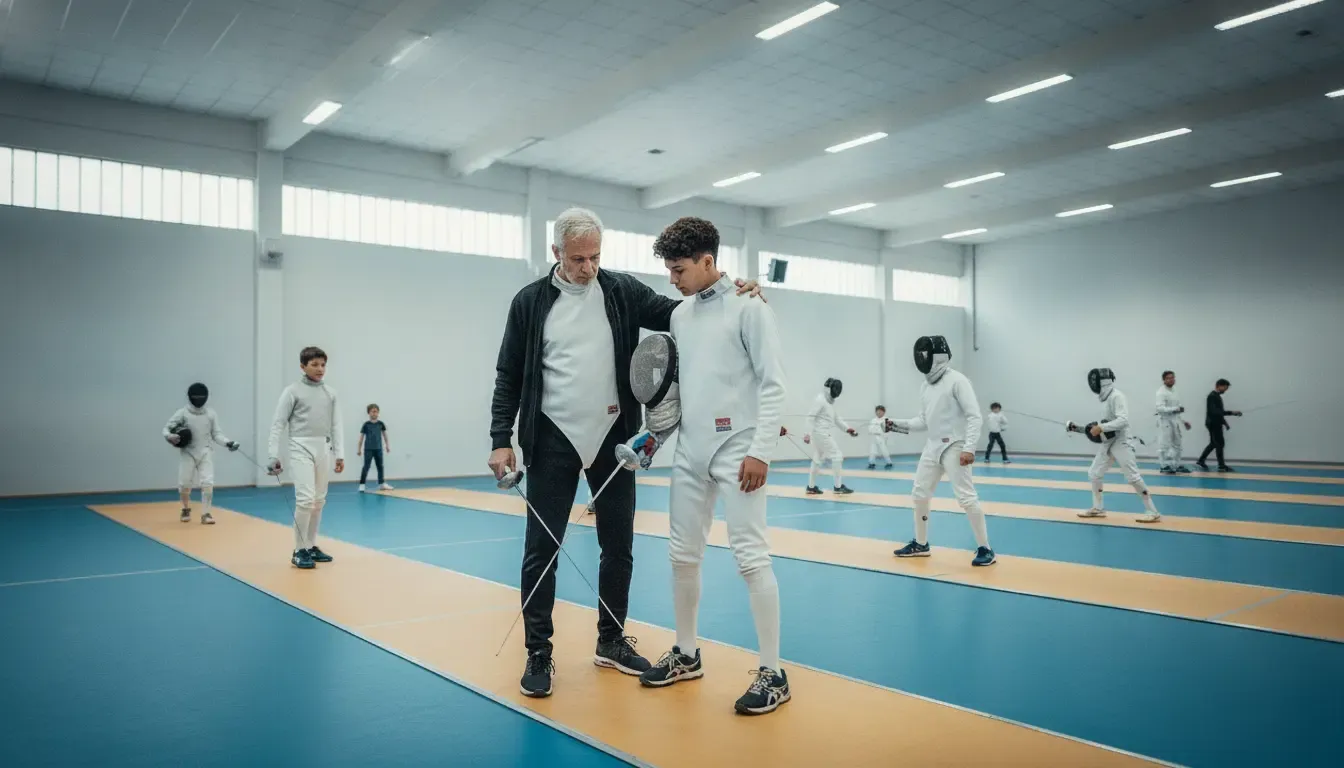
Group classes build a repeatable foundation
Weekly group classes give beginners regular practice and the chance to learn alongside other students. Repetition helps a fencer recognize the same movement in different situations. The coach can also adjust an exercise for different experience levels, which helps students improve without treating every beginner as if they started at the same point.
Private lessons add individual feedback
Private lessons are designed for FSA members and can be tailored to a student’s needs. FSA describes lessons in 20-minute increments, with recurring scheduling options subject to coach availability. One-on-one time can be useful when a fencer needs focused help with footwork, blade work, preparation for an event, or a specific technical habit.
Camps and clinics create focused practice blocks
Seasonal camps and specialty clinics can give students a concentrated opportunity to practice. FSA’s camp information describes beginner through advanced formats, small group instruction, and training that can include technique, discipline, and competition preparation. Confirm the current schedule, level requirements, and availability with the academy before making plans.
How can Gaithersburg families compare class options?
Compare fencing class options by the job each one solves. Weekly classes are the usual foundation for consistent learning, private lessons provide individualized attention for members, and camps or clinics offer focused training during available sessions. A new fencer may use more than one option over time.
| Training option | Best starting question | Possible role in development |
|---|---|---|
| Weekly group class | Is this level appropriate for a first-time student? | Builds regular habits, basic technique, and comfort in the club. |
| Private lesson | What skill would benefit from individual coaching? | Adds targeted feedback for an FSA member when a coach is available. |
| Camp or clinic | Does the session match the student’s age and experience? | Creates a focused block for technique, training, or competition preparation. |
| Open bouting or competition activity | Has the coach said the student is ready for this format? | Applies skills in a supervised setting after foundational instruction. |
Do not choose a program only because it sounds advanced. The most useful option is the one that matches the student’s current skill, available time, and reason for fencing. A recreational beginner may need consistent group practice, while a competition-minded athlete may later add private lessons and camps after establishing reliable fundamentals.
What should you ask before enrolling from Gaithersburg?
Before enrolling, ask about the correct beginner level, class availability, equipment for new students, the club’s Fairfax location, and how the academy recommends progressing. Also ask what the student should wear, how membership works, and whether a first visit or trial option is currently available.
- Which class is the right starting point for a student with no fencing experience?
- Does the program introduce foil, epee, sabre, or a specific weapon first?
- What equipment is provided or recommended for the first session?
- How does the coach adapt instruction for children, teens, or adults?
- What does the weekly schedule look like right now?
- When should a student consider private lessons, camps, or competition activities?
- What is the best way to contact the office about the First 2 Weeks Free offer?
FSA is located at 10310 A Main Street, Fairfax, VA 22030. Families should plan the trip from Gaithersburg before enrolling and confirm current class details directly with the academy. The FSA coaching staff page is also a useful place to review the team’s national, international, and Olympic-level experience.
FAQ: Fencing classes Gaithersburg MD
Families comparing fencing classes Gaithersburg MD can begin by confirming the student’s level, the current FSA schedule, equipment expectations, and the Fairfax location. A phone conversation with the academy can clarify the best first class and whether the First 2 Weeks Free offer applies.
How often should a beginner attend fencing class?
Consistency matters more than cramming. Many beginners benefit from a regular weekly class so they can revisit stance, footwork, and basic blade skills while the coach tracks progress. Ask FSA which current class frequency fits the student’s age, goals, schedule, and recovery needs.
Does a beginner need fencing equipment at home?
Ask the academy what is supplied for an introductory class before buying equipment. Beginners should not practice with a fencing weapon or protective gear without learning correct handling from a qualified coach. A clear, safe practice area may be useful for simple movement homework only when the coach recommends it.
Can children and adults start fencing at FSA?
FSA serves beginners through advanced athletes and offers youth and adult program options. The best class depends on the student’s age, experience, and current schedule. Contact the academy to confirm the appropriate class rather than assuming one session fits every age group.
Is FSA close enough for a Gaithersburg family?
FSA’s verified facility is in Fairfax, Virginia, not Gaithersburg. Families should compare the drive, class schedule, and training fit before enrolling. For a student who values structured Olympic fencing instruction, the right decision is the program that can be attended consistently and safely.
Can a beginner eventually compete?
Yes, a beginner can discuss competition when the coach believes the student has the necessary foundation and readiness. FSA’s development pathway includes local and national competition opportunities for athletes who choose that direction. Competition should be introduced progressively, with attention to skills, rules, equipment, and the student’s goals.
Fencing is a skill-based sport, and better movement comes from patient repetition under qualified supervision. If your family is ready to explore Olympic fencing from Gaithersburg, contact Fencing Sports Academy to discuss the current beginner path in Fairfax.